
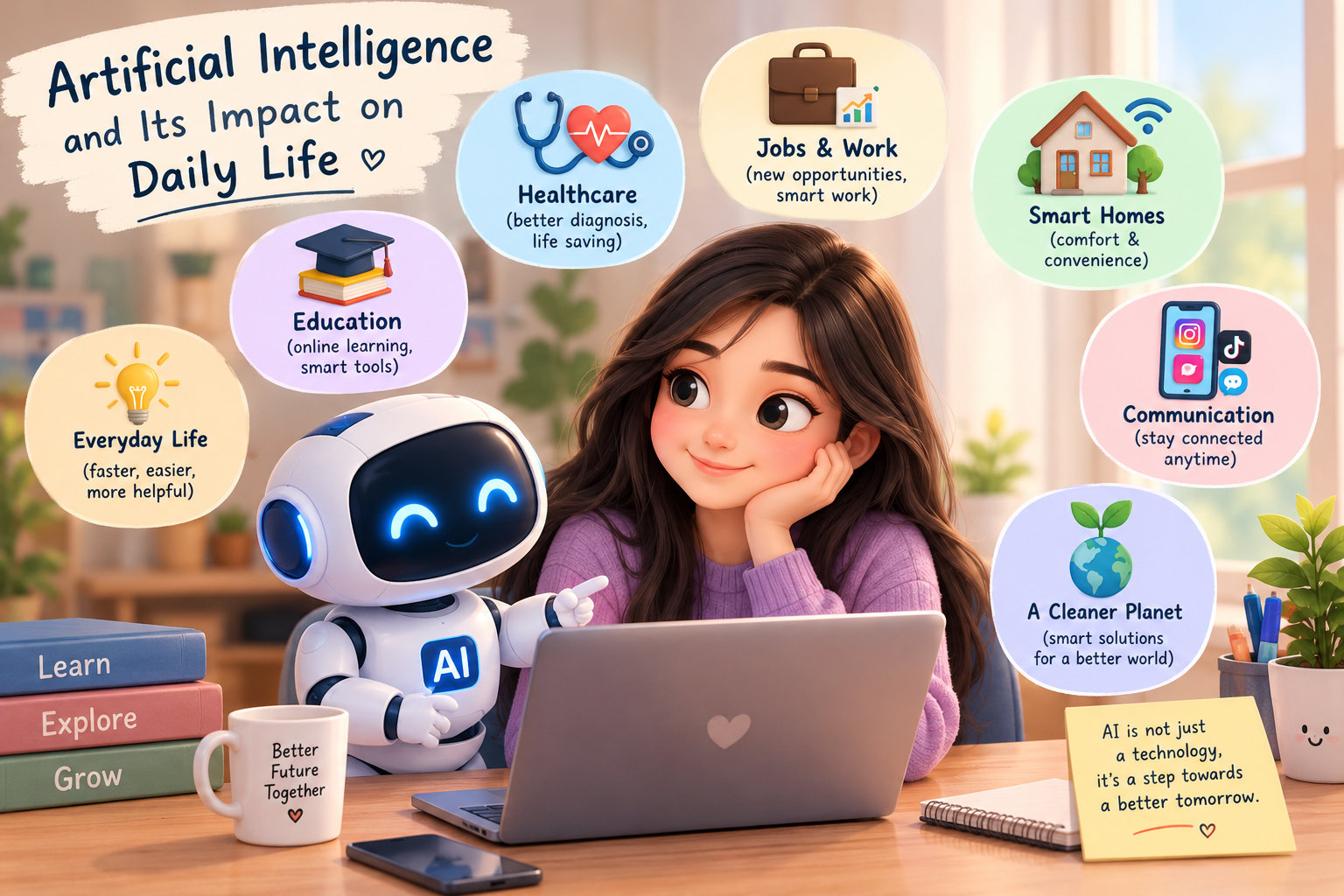
When I dug into this, # Artificial Intelligence and Its Impact on Daily Life ## 1. Here's the thing: introduction Technology has become an important part of our daily lives. We use smartphones, computers, the internet. Many other digital devices every day. One of the most important technological developments in recent years is Artificial Intelligence (AI). Artificial Intelligence is changing the way people live, work, study, and communicate. From voice assistants and online shopping recommendations to healthcare and education, AI is helping people perform many tasks more quickly and easily. Although AI offers many benefits, it also creates challenges related to privacy, employment. Human dependence on technology. This article explains what Artificial Intelligence is, how it affects our daily lives, its advantages and disadvantages. What we can expect from AI in the future. ## 2. What's Artificial Intelligence? Artificial Intelligence, commonly known as AI, is a technology that enables computers and machines to perform tasks that usually require human intelligence. These tasks include understanding language, recognizing images, solving problems, learning from data, and making predictions. For example, when we ask a voice assistant a question, receive recommendations on YouTube, or use a chatbot to find information, we're interacting with AI technology. AI systems use data, computer algorithms. Different learning methods to perform specific tasks. However, AI doesn't think or feel exactly like a human being. Its abilities depend on how it's designed, trained, and used. ## 3. How Artificial Intelligence Is Used in Daily Life Artificial Intelligence is already present in many areas of our everyday lives. Some common examples are discussed below. 1 AI in Education AI is transforming the education system by making learning more accessible and personalized. Students can use AI-powered educational applications to understand difficult concepts, practice questions, improve their writing, and learn new languages. AI tools can also help teachers prepare learning materials, organize educational activities. Identify areas where students need additional support. For example, a student who finds mathematics difficult can use an AI learning tool to receive step-by-step explanations and additional practice questions. However, students should use AI as a learning assistant rather than depending on it for every answer. Independent thinking and personal effort remain essential for effective learning. 2 AI in Healthcare Artificial Intelligence is becoming increasingly useful in healthcare. It can help medical professionals analyze medical images, identify patterns in health data, support research. Assist with certain diagnostic tasks. AI-powered applications can also remind people to take their medicines, track physical activity. Monitor some health measurements through compatible devices. For example, an AI system may help a doctor identify a possible problem in a medical image. The doctor must still evaluate the findings and make appropriate clinical decisions. AI can support healthcare services. Yet, it can't replace professional medical judgment in every situation. 3 AI in Communication Communication has become easier because of AI-powered technologies. Translation applications help people communicate in different languages, while speech recognition tools convert spoken words into written text. AI can also help users write emails, summarize long messages, and improve grammar. For example, someone who doesn't understand another language can use an AI translation tool to understand a message more easily. These technologies help connect people from different countries and cultural backgrounds. 4 AI in Business and the Workplace Many businesses use AI to improve productivity and manage daily activities. AI systems can organize information, analyze data, answer common customer questions. Automate repetitive tasks. For example, an online store may use an AI chatbot to answer customers' questions about products, delivery, and returns. AI can save time and help employees focus on tasks that require creativity, communication, and decision-making. However, automation may also change some jobs. Workers may need to learn new skills to adapt to changing workplace requirements. 5 AI in Transportation Artificial Intelligence is helping improve transportation systems. Navigation applications use data and intelligent algorithms to suggest routes, estimate arrival times. Identify traffic conditions. AI is also used in driver-assistance systems that can help detect nearby vehicles, recognize certain road hazards, and support safer driving. For example, a navigation application may suggest an alternative route when heavy traffic is detected. Although these systems can be useful, drivers must remain attentive and follow traffic laws. 6 AI in Smart Homes Smart home devices use AI and automation to make household activities more convenient. Some devices can respond to voice commands, adjust lighting, manage heating and cooling, or help monitor home security. For example, a person can use a voice assistant to turn off compatible smart lights without manually operating a switch. These technologies can save time and improve convenience. However, users should understand the privacy settings of their devices and protect their home networks. 7 AI in Entertainment and Online Shopping AI influences the content people see on digital platforms. Streaming services, social media applications, and online stores use recommendation systems to suggest videos, music, products, and other content based on user activity. For example, YouTube may recommend videos related to topics a person has previously watched. These recommendations can help users discover interesting content. At the same time, spending too much time following personalized recommendations may reduce productivity and increase screen time. ## 4. Advantages of Artificial Intelligence Artificial Intelligence offers several important advantages. **1. Saves Time:** AI can complete many repetitive tasks quickly, allowing people to focus on other activities. **2. Improves Productivity:** AI tools can help individuals and organizations complete certain tasks more efficiently. **3. Supports Learning:** AI-powered educational tools can provide explanations, practice exercises. Personalized learning support. **4. Assists Healthcare:** AI can help healthcare professionals analyze information and support medical research. **5. Improves Accessibility:** Speech recognition, translation. Text-to-speech tools can make digital information more accessible to different users. **6. Supports Better Decisions:** AI can analyze large amounts of data and identify patterns that may help people make informed decisions. **7. Encourages Innovation:** AI creates opportunities for new products, services, research, and careers. ## 5. Disadvantages and Challenges of Artificial Intelligence Despite its benefits, Artificial Intelligence also presents several challenges. 1 Privacy Concerns Some AI applications collect or process personal information. If this information isn't handled securely, it may create privacy risks. People should avoid sharing sensitive personal information with untrusted AI tools and should review application privacy settings. 2 Changes in Employment AI can automate certain tasks that were previously performed by humans. This may reduce demand for some types of work while creating new opportunities in other areas. Learning digital skills, problem-solving, communication. Other relevant abilities can help workers adapt to these changes. 3 Overdependence on Technology Relying too heavily on AI can reduce opportunities to practice independent thinking and problem-solving. For example, students who copy AI-generated answers without understanding them may struggle when they need to solve similar problems independently. Therefore, AI should support human learning rather than replace personal effort. 4 Incorrect Information AI systems can sometimes produce inaccurate, incomplete, or misleading information. Their responses should not automatically be considered correct. Users should verify important information through reliable sources, especially when dealing with health, legal, financial, or academic matters. 5 Bias and Unfairness AI systems learn from data. That data may contain errors or existing biases. As a result, an AI system may produce unfair outcomes in certain situations. Developers and organizations need to evaluate AI systems carefully to improve fairness, transparency, and accountability. 6 Security Risks AI can be misused to create misleading content, imitate voices, or support online scams. Such activities can make it more difficult to distinguish genuine information from manipulated content. People should verify suspicious messages, protect their accounts. Think carefully before sharing information online. ## 6. The Impact of AI on Human Life Artificial Intelligence affects not only how people complete tasks but also how they learn, interact, and make decisions. In education, AI can provide quick explanations and learning support. In the workplace, it can help people organize information and complete routine tasks. In communication, it can connect people across language barriers. However, the effects of AI depend on how people use it. Excessive dependence on digital tools may reduce opportunities for direct social interaction or independent problem-solving. For this reason, people should maintain a healthy balance between technology and real-life activities. Human relationships, emotional understanding, creativity. Personal responsibility remain important parts of everyday life. ## 7. The Future of Artificial Intelligence The future of Artificial Intelligence is expected to bring further changes to education, healthcare, business, transportation, and communication. AI tools may become more helpful in supporting personalized education, scientific research, environmental monitoring. The development of new services. Businesses may use AI to improve their operations, while healthcare professionals may benefit from better tools for analyzing medical information. At the same time, society will need clear rules and responsible practices to address privacy, safety, fairness, and employment concerns. The goal should be to develop AI that benefits people while respecting human rights, personal privacy. Individual decision-making. ## 8. How Can We Use AI Responsibly? Responsible use of Artificial Intelligence is essential for gaining its benefits while reducing potential risks. Here are some useful guidelines: - Verify important information instead of trusting every AI-generated answer. - Protect personal information and avoid sharing passwords or sensitive details. - Use AI to support learning, creativity. Productivity rather than avoiding personal effort. - Respect copyright, academic rules, and other people's privacy. - Check AI-generated content for errors, bias, and misleading information. - Continue developing human skills such as critical thinking, communication, creativity, and problem-solving. - Use digital devices in a balanced way and make time for real-life relationships and activities. By following these practices, people can make better use of AI in their personal, educational, and professional lives. ## 9. Conclusion Artificial Intelligence has become an important part of modern life. It's changing how people learn, communicate, work, travel, shop, and access information. AI offers many benefits, including convenience, productivity, accessibility. Support for scientific and medical research. However, it also raises concerns about privacy, employment, misinformation, fairness. Overdependence on technology. Artificial Intelligence is a powerful tool. Yet, its value depends on how responsibly it's developed and used. Instead of relying on AI for everything or fearing every new development, people should learn to use it wisely. **The future of AI should not simply be about making machines more intelligent. **
Artificial Intelligence and Its Impact on Daily Life
I tested this firsthand: artificial Intelligence and Its Impact on Daily Life 1. In practice, introduction Technology has become an important part of our daily lives. We use smartphones, computers, the internet. Many other digital devices every day. One of the most important technological developments in recent years is Artificial Intelligence (AI). Artificial Intelligence is changing the way people live, work, study, and communicate. From voice assistants and online shopping recommendations to healthcare and education, AI is helping people perform many tasks more quickly and easily. Although AI offers many benefits, it also creates challenges related to privacy, employment. Human dependence on technology. This article explains what Artificial Intelligence is, how it affects our daily lives, its advantages and disadvantages. What we can expect from AI in the future.
Comments (0)
Log in to leave a comment.
No comments yet. Be the first to share your thoughts!